
The Best MBA Programs in Germany Compared Head-to-Head (2026)
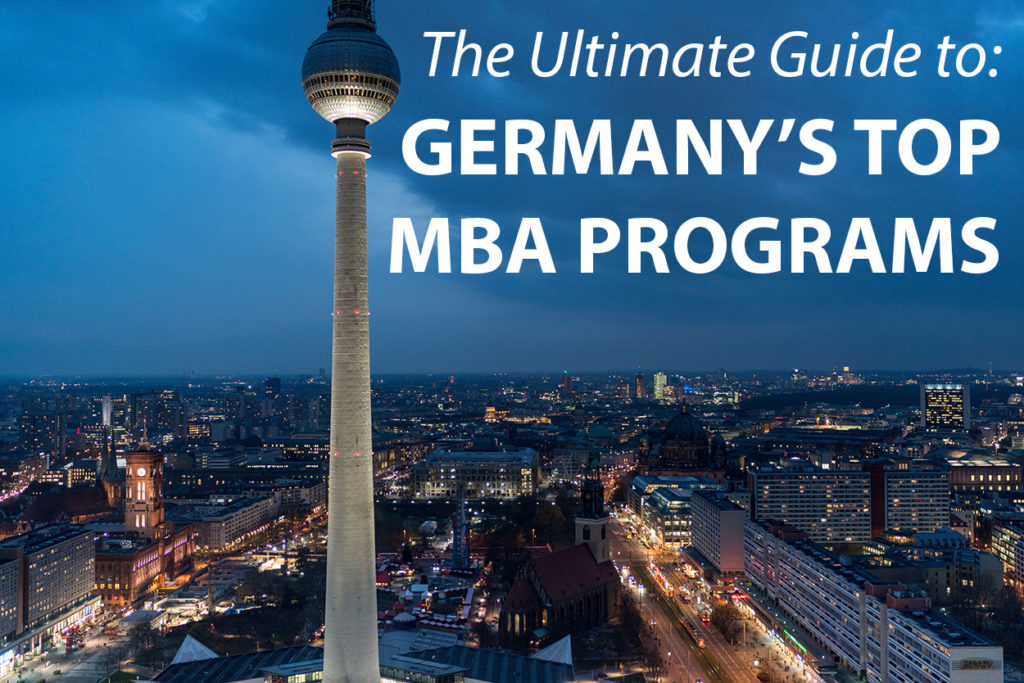
Photo courtesy of Matthias Ripp via Flickr.
Looking for the best full-time MBA programs in Germany? Here’s your ultimate guide. Read on to compare Germany’s top MBA programs head-to-head and get application tips from Admissions Directors from Germany’s best MBA programs. All on one page!
Last updated: March 2026
Data sources: (1) German business school websites, brochures, and employment reports (2) Global MBA rankings data including: Financial Times MBA Rankings, QS Top MBA Rankings (3) Touch MBA Podcast Interviews and data requests
-
Snapshot of Top MBA Programs in Germany
-
Why Germany for Your MBA?
-
Top Full-time MBA Programs in Germany
-
In-Depth Podcast Interviews with MBA Admissions Directors from Germany’s Top Business Schools
-
Post-MBA Career Opportunities in Germany – Visas, Industries, and More
-
ESMT Berlin MBA vs. WHU MBA vs. Mannheim MBA vs. Frankfurt MBA – In-Depth Head-to-Head Comparison
-
Get Help Finding Your Best-Fit MBA Program in Germany
Snapshot of Top MBA Programs in Germany
| MBA Program (Location) | Length | Class Size | Tuition | Avg Starting Salary (rounded) | Avg Salary after 3 Years |
|---|---|---|---|---|---|
| Mannheim MBA | 12-15 months | 50-60 | €47,000 | €101,000 | $148,000 USD |
| ESMT Berlin MBA | 15 months | 40 | €50,000 | €81,000 | $132,000 USD |
| WHU MBA | 12 months | 40-50 | €49,500 | €76,000 | $134,000 USD |
| Frankfurt MBA | 12 months | 40 | €42,000 | not available | $125,000 USD |
Why Germany for your MBA?
4 Reasons to Get Your MBA in Germany
1. Germany’s top business schools are relatively affordable, offer “early bird” discounts for applying early to their 12-15 month MBA programs, and offer international, high-touch learning experiences. The average tuition for the four programs surveyed in this guide is €47,125, while the average starting salary for MBA graduates hovers near €86,000. The top business schools hold international accreditations and entrepreneurial spirits. German MBA programs are relatively young but have broken into international rankings and are gaining recognition in the global marketplace.
2. Earning your MBA in Germany gives you a high probability of ending up in the country post-graduation, even if you’re an international student. Upwards of 70 percent of MBA graduates stay and work in Germany post-graduation. Recent graduates are also eligible to apply for a residence permit, which allows them to stay in the country for 18 months to look for a job.
3. Germany boasts a high standard of living with a low cost, especially in comparison to other Western European nations. The Federal Ministry of Education and Research estimates that students spend an average of about €1,000-1,200 per month on living expenses.
4. Germany has the largest economy in Europe (comprising 25 percent of European GDP), is Europe’s prime logistics hub, and is one of the world’s leading countries for foreign direct investment. Germany is responsible for 6.5 percent of the world’s exports (ranking third worldwide), and is also known for its strong engineering, technology and manufacturing industries.
Top Full-Time MBA Programs in Germany
Click on school name to get a full writeup and in-depth podcast interview exploring what makes each program unique
ESMT Berlin (ESMT Berlin)
- ESMT Berlin was founded in 2002 by a conglomerate of 25 leading global companies to provide practical, quality management education to the country’s future business leaders. These founding companies represent diverse industries and include KPMG, BMW, and Lufthansa.
- The school calls Berlin, Germany’s capital and most populous city, home. The city is a business and cultural hub for Europe, too, as well as being much more affordable than other major cities on the continent. Startup Heatmap ranked Berlin the #2 startup hub in Europe.
- ESMT Berlin students can specialize in Managerial Analytics or Entrepreneurship & Innovation
- ESMT Berlin is an entrepreneurially minded program with many graduates pursuing careers in the tech industry. Twenty percent of the Class of 2024 found roles in the technology industry, 20 percent in consulting, and 10 percent in e-commerce.
- ESMT Berlin’s Responsible Leaders Fellowship gives students the opportunity to extend their studies by up to six months to complete a social impact project in a developing country; ESMT pays a stipend, covers travel, and can help students find a fellowship.
WHU – Otto Beisheim School of Management (WHU)
- WHU’s full-time MBA campus is located in Dusseldorf, a creative center and start-up hub in Germany. More than 400 advertising agencies call the city home, as well as hundreds more startups. The tech industry has a heavy presence in the city.
- WHU has been the #1 MBA in Germany for the past 3 years in the Financial Times, focused on a general management MBA curriculum
- MBA students spend 30 days abroad (1/12th of the MBA program) studying in the US (Kellogg), Europe, and elsewhere for their Social Entrepreneurship and Final MBA projects.
- After graduation, alumni have free access to MBA courses and workshops on campus for continuous professional development and networking.
Mannheim Business School (MBS)
- QS Global ranked the Mannheim as the #1 ROI MBA Program in the world in 2025
- Students at MBS have impressive access to major companies, while enjoying the lifestyle and cost-of-living of a mid-sized city. Fifty percent of the major German companies are located within a 250-kilometer radius of Mannheim, a major business hub. Many multinationals, including Unilever, Siemens, and IBM, all have offices in the city.
- Every student participates in a Social Sustainability Project and Business Master Project. Sustainability makes up 20% Mannheim’s course content in any discipline. Students can extend their studies for 3 months to go on student exchange, intern, or work on a startup.
- Mannheim MBA graduates top 3 destinations are Multi-National Companies, Consulting Firms, and Startups; 80 percent work in Germany and the EU. MBS students can take advantage of the country’s strong industrial sector, with both major companies and startups neighboring the school.
Frankfurt School of Finance & Management
- The Frankfurt School was founded in 1957 (as Bankakademie e.V.) to provide professional education for bank employees; rebranded as The Frankfurt School of Finance and Management, it now provides bachelors, masters and executive education, as well as international advisory services to financial institutions and NGOs
- Frankfurt, a regional financial center, is known for its skyscrapers, the European Central Bank and large expat community
- The Frankfurt School is triple accredited by AACSB, EQUIS and AMBA, and entered the Financial Times Top 100 MBA Rankings for the first time in 2023
- MBA students major in Advanced Management or Finance & Technology
- Tuition, at 42,000€, is the most affordable amongst the German MBAs in this guide; applicants can also get discounted tuition (up to 14%) by applying in earlier rounds
Insider Interviews with German MBA Admissions Directors
Listen to our in-depth interviews about what makes each MBA program unique and what you can do to give yourself the best chance of getting in:
Application Tips from MBA Admissions Directors
“I like people who think a little bit differently, who are unafraid to challenge the status quo, who are authentic, reflective and are able to verbalize why the ESMT Berlin MBA is the right fit for them and why Germany.” – Rebecca Loades, Director of MBA Programs, ESMT Berlin
“Students need to be team players because WHU is a collaborative MBA… we do a lot of group work so this is an integral part of candidate fit, in my opinion. And also be open to be learning about themselves… this is one of the most difficult parts, to see your blindspots and work on your weaknesses in front of others… and this is something students need to be open to.” – Sabine Noe, Director of Recruitment & Admissions, MBA Programs, WHU
“We look at more than 20 different criteria… we are looking at a comprehensive profile. We are looking for people who are collaborative, as we want to have in-depth learning in the classroom. We’re looking for people who are great in teamwork, who can teach other people but at the same time are also able to listen. Every one of our candidates should bring value to the rest of the classmates.” – Kai Stenzel, Chief Market Officer, Mannheim Business School (MBS)
“Try to see how you stand out, because all schools look for a diverse profile. Tell them what you did before, what challenges you had, tell them about your experiences, and honestly for me and many others, that’s much higher on the list than a few more GMAT points. The GMAT points are important, but we’re looking for people that go out and have an impact on the business world and society and these are skills you can’t always test for.
Whenever I start an interview, I tell the person, ‘Tell me for 3-4 minutes who you are?’ And this is something you can prepare. Prepare how you introduce yourself. What’s your background? What’s your experience? Why do you want to do an MBA? What’s your target and does an MBA help you achieve your target? It’s good to see what people want to do in the long run.” – Adrian Buss, Academic Director of MBA Programs, Frankfurt School of Finance & Management
Touch MBA’s Advice for Applying to Top German Business Schools
- Apply early, as all four programs mentioned offer substantial tuition discounts (often more than 10%!) to admitted students who apply in earlier rounds
- Upwards of 70% of MBA graduates from Germany’s top MBA programs work in Germany after graduation; demonstrating interest in the region and German language skills would be a plus
- Take advantage of the fact that top German business schools are willing to meet and guide you before you apply
What’s Next?
Interested in seeing how you stack-up against applicants to the WHU, Mannheim, ESMT Berlin or Frankfurt MBA programs? Submit your profile to get an early indication of fit.
Contact our team to get free b-school selection help.
Post-MBA Career Opportunities in Germany
- Visa – Germany is perennially ranked as one of the top European countries for international students and student visas are simple to arrange once admitted to a program. Upon graduation, students can apply for a residence permit and are allowed to stay in the country for up to 18 months to look for a job. Graduates of German universities are also able to stay in the country as either self-employed or to set up a business, particularly if their venture is related to their studies. If your business is successful, this can lead to permanent residency in the country.
- Taxes – Income tax rates in Germany are adjusted according to one’s income and range from 0 to 45 percent
- Geography – Situated in the heart of Western Europe, Germany borders 9 nations and is ideal for traveling around the continent and beyond. Domestic and international transportation systems – ranging from buses, to trains, to planes, to cars, to bicycles – are abundant and efficient. Germany is also in the Schengen Area, allowing 450 million people visa-free travel across 29 European countries.
- Industry – Germany boasts the largest economy in Europe (comprising nearly 25 percent of European GDP) and the third largest economy in the world. It’s well-known for its manufacturing industry, particularly related to cars and mechanical engineering. BMW, Mercedes-Benz and Volkswagen were all founded in the country. In 2025, services made up 70 percent of Germany’s GDP and industry made up 25-30 percent of GDP. Sixty percent of Germany’s workforce was employed by “Mittlestand” – small (<500 employees), family-owned companies under €50 million in annual revenue. Germany is home to the top 3 startup hubs in 2026, as ranked by the Financial Times.
- Return on Investment – In 2026, Financial Times ranked top German MBA programs as follows for value for money (worldwide): Mannheim, #35; Frankfurt, #50; ESMT Berlin, #67; WHU, #69.
Head to Head – ESMT Berlin MBA vs. WHU MBA vs. Mannheim MBA vs. Frankfurt MBA
Want a comprehensive picture of Germany’s leading MBA programs? Read below for a head-to-head comparison of schools with detailed info on admissions, curricula, job placements and more.
Comparison table best viewed on bigger screen. Last updated March 2026
| ESMT Berlin MBA | WHU MBA | Mannheim MBA | Frankfurt MBA | |
|---|---|---|---|---|
| Degrees Offered | MBA | MBA | MBA | MBA |
| Class Size | 40 | 40-50 | 50-60 | 40 |
| GMAT (avg) | not available | not available | not available | not available |
| Age (avg) | 30 | 29 | 31 | 30 |
| Work Exp (avg) | 6 | 5 | 7-8 | 5-6 |
| No. Nationalities | 20 (90% international) | 20 (80% international) | not available | 17 (80% international) |
| Start Date | January | September | September | September |
| Length | 15 months | 12 months | 12-15 months | 12 months |
| RANKINGS | ||||
| Financial Times 2026 (2025, 2024) | 79 (80, NR) | 69 (66, 63) | 87 (71, 73) | 92 (96, NR) |
| Notable Rankings | #1 German business school in Financial Times European Business School Ranking (2025); #1 in Germany for Entrepreneurship in Poets&Quants World’s Best MBA Programs for Entrepreneurship Ranking (2025) | #1 German MBA by Financial Times for past 3 years | #1 ROI worldwide by QS Global MBA Only German MBA (#8) in Bloomberg Businessweek ranking for European MBAs 2025-26 | #1 Business School in Germany for Employability by Times Higher Education 2025 |
| ADMISSIONS | ||||
| Requirements | Undergraduate degree or equivalent professional qualification 3+ years of work experience GMAT/GRE/GMAC EA/ESMT Business Admissions Test score English language fluency (minimum TOEFL iBT 95, IELTS 7) | Undergraduate degree 2+ years of work experience GMAT Focus (555 or higher recommended)/GRE (310 or higher recommended)/WHU Business Admissions Test/CFA Level2/PhD/others English language fluency (TOEFL 100 IBT, IELTS 7) | Undergraduate degree or equivalent professional qualification 3+ years of work experience GMAT (minimum 600), GMAT Focus (minimum 565) or GRE equivalent English language fluency (minimum TOEFL iBT 95, IELTS 7) | Undergraduate degree 3+ years of work experience GMAT or GRE preferred or Frankfurt Business Admissions Test/CFA Level 2/PhD/others English language fluency (minimum TOEFL iBT 95, IELTS 7) |
| Deadlines | Round 1 - Mar 1 Round 2 - Mar 31 Round 3 - May 17 Round 4 - Jun 30 Round 5 - Jul 31 Round 6 - Sep 15 Round 7 - Oct 31 Round 8 - Dec 8 Early Bird Deadlines: Mar 1: € 6,000 off tuition fees Mar 31: € 6,000 off tuition fees May 17: € 3,000 off tuition fees Jun 30: € 1,500 off tuition fees | Round 1 - Apr 30* Round 2 - May 31** Round 3 - Jul 15 * applicants requiring APS (China, Vietnam, India) ** applicants requiring visa Early Bird Deadlines: Sep 30: € 6,000 off tuition fees Nov 30: € 5,000 off tuition fees Jan 31: € 4,000 off tuition fees Mar 31: € 3,000 off tuition fees | Round 1 - Nov 30 Round 2 - Jan 31 Round 3 - Mar 31 Round 4 - Apr 30 Round 5 - Jul 31 The school offers early bird tuition discounts to those who apply in the first four rounds (€4,000 off, €3,000 off, €32000 off, €1,000 off) €200 discount if your GMAT is 650 (GMAT Focus 615) or higher | Rolling admissions Round 1 - May 31** Round 2 - July 31 ** for applicants requiring visa Early Bird Deadlines: Nov 30: € 6,000 off tuition fees Feb 28: € 5,000 off tuition fees May 31: € 4,000 off tuition fees |
| Application Fee | €100 | €0 | €150 | €0 |
| Tuition | €50,000 | €49,500 | €47,000 | €42,000 |
| Est Annual Living Costs | €1,000-1,500/month | €1,000-1,200/month | €1,000-1,200/month | €1,500/month |
| Application Materials | Online application TOEFL or IELTS score (if non-native English speaker) GMAT/GRE/EA/ESMT Admissions Test score Three short essays Two recommendations CV Official transcripts from past degrees/studies Interview (if selected) | Online application TOEFL or IELTS score (if non-native English speaker) Excellent Fit Assessment Form (GMAT or GRE score recommended) Short answer questions in completed questionnaire One letter of recommendation CV Official undergraduate degrees and transcripts Interview (if selected) | Online application form TOEFL or IELTS score (if non-native English speaker) GMAT or GRE score recommended Three short answer questions Two recommendations CV Official undergraduate degrees and transcripts Interview (if selected) Photo Evidence of payment of application fee APS for applicants from China, India, Vietnam | Online application form TOEFL or IELTS score (if non-native English speaker) GMAT or GRE score recommended Three short answer questions Two recommendations CV Official undergraduate degrees and transcripts Interview (if selected) Photo Evidence of payment of application fee APS for applicants from China, India, Vietnam |
| International Opportunities | Students can study at HEC Paris (France), IE (Spain), NUS (Singapore), Peking University (China), EGADE (Mexico), Smith (Canada), HKUST (Hong Kong) for 6-12 weeks Students can study at one of 31 other GNAM business schools globally for one week. Responsible Leaders Fellowship - a fully-funded social impact project for up to six months post-MBA in a developing country. | Study 30 days abroad in: 6 days in USA (Kellogg) 6 days for European course experience 10 days Social Entrepreneurship Project 8 days Leadership Credo | Includes a study trip to a business school located at an international business hub where you will attend a mandatory course | 1 week core course “Innovation” taken abroad at SDA Bocconi in Italy |
| Scholarships | Awards 9 categories of scholarships up to 50% of fees. Applicants automatically awarded for demonstrating German language skills (up to €5,000), Test Score Excellence, or applying in the earliest rounds | Awards 8 categories of merit and need-based scholarships "on an individual basis based on various criteria" Applicants automatically awarded for applying in the earliest rounds | 4 types of scholarships available, and offered on a rolling basis subject to availability Applicants automatically awarded for applying in the earliest rounds | 6 types of scholarships available, up to 30% of tuition, and offered on a rolling basis subject to availability |
| Location | Berlin Germany's cultural, political and startup capital and largest city. ESMT is based in Mitte, Berlin’s central neighborhood. | Dusseldorf Dusseldorf is a creative, startup hub in Germany, and has been ranked as one of the most livable cities in the world. | Mannheim In addition to being a German business hub - IBM, Siemens, Unilever and other major multinationals have offices in the city - it's been dubbed an "UNESCO City of Music." | Frankfurt The financial center of Germany, housing the European Central Bank. |
| PROGRAM | ||||
| Core Curriculum | Five modules: Module 1: Core Courses Module 2: Summer Internship, Language School, Sustainability in practice Module 3 & 4: Specialization through Electives, Exchange Module 5: Capstone Consulting Project Introduction to General Management Introduction to Economic Thinking Managerial Analysis and Decision Making Inclusive Leadership Macroeconomics Business Ethics From Analytics to AI Marketing Management Operations & Supply Chain Financial Accounting Management Accounting Finance Structured Thinking Building High Performance Teams Competitive Strategy Quantitative Methods Evidence Based Management Organizational Behavior | 13 core courses, 2 electives, Social Entrepreneurship Project, Final MBA project Strategy Financial Accounting Marketing Entrepreneurship Economics Statistics Data Science & AI Operations Finance Governance Sustainability Innovation Management Accounting | 10 core courses, as well as a Social Sustainability Project and Business Master Project: Financial Accounting Marketing Strategic Management Corporate Finance Macroeconomics Managerial Accounting Organizational Behavior & Change Management Operations Management Ethics & CSR Qualitative & Quantitative Research Methods | 7 core courses over 6 months, electives over 3 months, Thesis over 3 months (Group Consulting Project, Entrepreneurial Business Plan, or Individual Research Project) Understanding Global Markets Corporate Financial Policies Leading People & Transformation Digital Strategy & Execution Managing Customers & Operations Financial & Sustainability Reporting Managing Operations & Impact |
| Electives | Options include: Customer Analytics Advanced Decision Modeling Machine Learning Human Factor of Innovation Creating and Capturing Value Entrepreneurial Finance & Valuation and more electives related to Sustainability, Digital transformation, Industry 4.0, Entrepreneurship, Leadership and Personal Mastery | Choose 2 electives, Social Entrepreneurship Project, Personal Development & Management Practice Workshops and Final MBA Project | Options include: Applied Corporate Finance From Data to Insights International Marketing Innovation & Creativity Management Corporate Mergers & Restructuring Global Corporate Strategy Business & Corporate Taxation Global Information Management Responsible Business Negotiation Consumer Behavior Supply Chain Management Strategic HR Management | Choose from 20 electives including: Alternative Investments & Future of Finance Managing Digital Transformation Organizational Design Sustainable Finance |
| Concentrations | Managerial Analytics Entrepreneurship & Innovation | Innovative Business & AI Market Strategy & Digital Transformation Strategic Transactions & AI Corporate Growth & Digital Transformation | Finance & Technology Advanced Management |
|
| CAREERS | Class of 2024 | Class of 2023 & 2024 | Class of 2024 | Class of 2024 |
| Placement w/in 3 months | 66% | 86% | 95% | 81% (Class of 2025) |
| Average Salary (Sign-On Bonus) Salary 3 years after graduation (Financial Times) | €80,855 (€98,500*) *Includes sign-on bonus $132,000 USD 3 years after graduation | €76,000 (€83,500*) *Includes sign-on bonus $134,000 USD 3 years after graduation | $117,500 USD $148,000 USD 3 years after graduation | not available $125,000 USD 3 years after graduation |
| Salary Increase (Financial Times) | 65% | 74% | 73% | 51% |
| Top Geographies | 90% Germany 5% Europe (not Germany) 5% Asia | 79% Germany 10% Europe (not Germany) 3% Mexico 2% India 2% Turkey | 80% Germany/EU 20% USA | 68% Germany 4% Europe (not Germany) 20% Asia 4% Africas 4% Americas |
| Top Industries | 20% Consulting 20% Technology 10% E-Commerce 10% Manufacturing 10% Energy 10% Retail 10% Media/Entertainment 5% Financial Services 5% Healthcare | 31% Tech/Startup/IT 15% Consumer Goods 11% Consulting 9% Manufacturing 7% Energy 7% Wholesale/Retail 6% Healthcare/Pharma 5% Finance/Insurance | Top 3 sectors are MNCs, Consulting and Startups | 20% Financial Service 16% Banking 16% Retail/E-Commerce 12% Manufacturing 8% Fintech 8% IT 4% Consulting 4% Life Sciences 4% Government Agency 4% Professional sports |
| Top Functions | not available | 27% Sales & Marketing 16% Finance 13% Business Development 12% Consulting 10% Project Management/Engineering 8% Operations/Logistics 4% General Management | not available | 24% Financial Services 20% Management & Strategy 12% IT 12% Sales 8% Marketing |
| Alumni | 10,000 school alumni worldwide in more than 98 countries. | More than 7,500 alumni with 35 regional chapters worldwide | More than 5,000 alumni with 80 regional chapters worldwide | More than 1,400 alumni, 60,000+ Frankfurt School Alumni |
Need More Help with German MBA Programs?
Get Free School Selection Help and an expert profile review from Touch MBA.
Hear from faculty, students, and alumni from ESMT Berlin, WHU and Mannheim about what makes Germany a destination for ambitious and innovative MBA students.
One thought on “The Best MBA Programs in Germany Compared Head-to-Head (2026)”
Great post! I’ve been using Free Image Generator (https://freeimagegenerator.app) for my projects and it’s been amazing. Really helpful content here!